
Get A Quote
Call Us Now


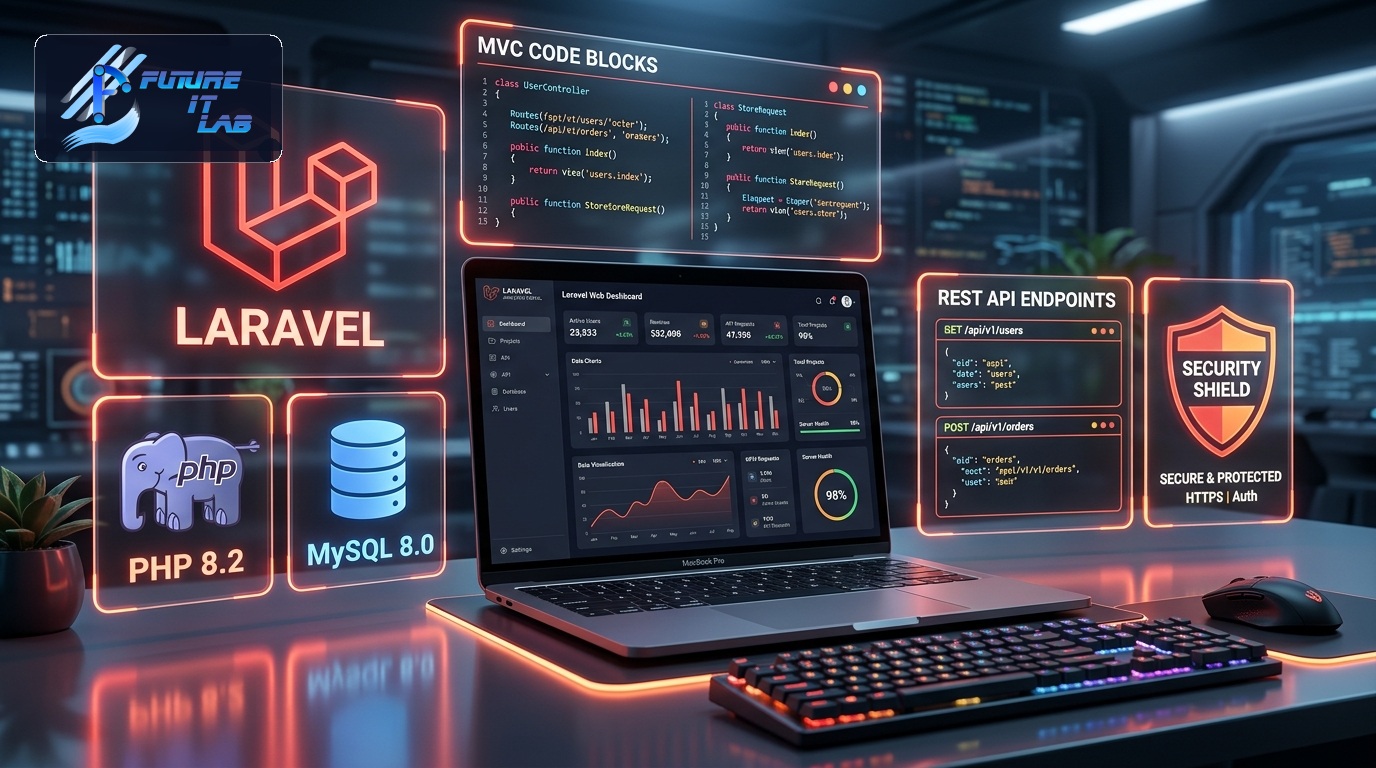
For years, outdated perceptions associated PHP with legacy scripts and unstructured code. In 2026, the modern PHP ecosystem—championed by Laravel—represents one of the most sophisticated, expressive, and high-performance development environments in modern software engineering. Powering global SaaS giants, fintech processors, e-commerce marketplaces, and high-concurrency enterprise portals, Laravel has earned its position as the premier web application framework for modern digital enterprises.
At Future IT Lab, Laravel serves as our foundational backend framework for custom web applications. In this technical deep-dive, we examine why Laravel continues to dominate enterprise software engineering and how its architectural features deliver unmatched scalability, security, and developer velocity.
Database interactions form the core of nearly every web application. Laravel’s Eloquent ORM (Object-Relational Mapping) implements an Active Record architectural pattern that combines clean syntax with advanced relational query construction.
with(['relation'])) and automatic N+1 query prevention in development mode.lockForUpdate()) ensures data integrity during financial and inventory transactions.Web applications that execute time-consuming operations (e.g., PDF generation, payment processing, sending transactional emails, webhook distribution) within the HTTP request cycle suffer from slow response times and frequent timeouts. Laravel’s native Queue System transforms synchronous bottlenecks into lightning-fast background workflows.
By pairing Laravel Queues with Redis and Laravel Horizon, enterprise systems achieve real-time visibility into queue throughput, runtime metrics, job retries, and failure backoff strategies. Key enterprise features include:
Security is non-negotiable for enterprise applications handling user data and commercial transactions. Unlike unopinionated micro-frameworks that require manual implementation of security safeguards, Laravel enforces enterprise security defaults out of the box:
{{ $variable }}), neutralizing malicious script injection.At the core of Laravel’s architecture is an Inversion of Control (IoC) Service Container. This powerful tool manages class dependencies and performs automatic dependency injection via reflection, enabling the construction of clean, testable, and loosely coupled enterprise software.
By binding interfaces to concrete service implementations within Service Providers, developers can effortlessly swap third-party vendors (e.g., switching between Paddle, Stripe, or Cryptomus payment drivers) without touching core business controllers—embodying the Open-Closed Principle of SOLID software design.
One of Laravel’s greatest modern strengths is its frontend flexibility. Engineering teams can choose the exact architectural paradigm suited for their project:
Laravel delivers the rare combination of rapid development speed, bulletproof architectural rigor, and enterprise scalability. For businesses seeking a future-proof web platform that scales gracefully from thousands to millions of requests, Laravel remains the unrivaled champion of the modern web.
At Future IT Lab, our team has built and deployed dozens of mission-critical Laravel platforms for clients worldwide. Browse our development services or request a consultation to discuss how we can engineer your custom Laravel solution.