
Get A Quote
Call Us Now


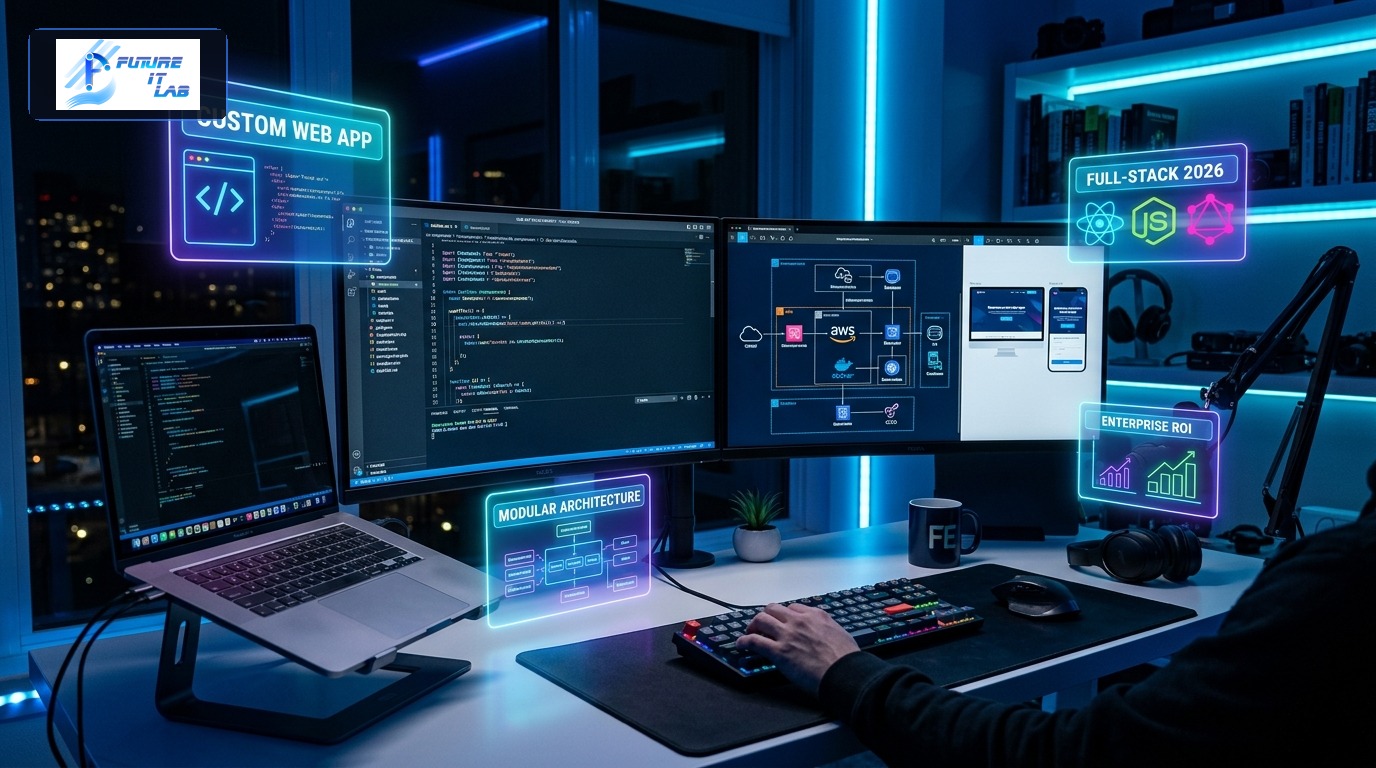
In the contemporary digital economy, off-the-shelf templates and generic website builders are increasingly falling short for ambitious businesses. Modern digital operations require tailored workflows, sub-second latency, rigorous data governance, frictionless third-party integrations, and scalable infrastructure capable of supporting exponential user growth. Custom web application development has transitioned from a competitive advantage to a foundational prerequisite for enterprise longevity.
At Future IT Lab, our engineering teams architect high-throughput, security-first web applications designed to solve bespoke business problems, automate complex organizational workflows, and deliver memorable digital experiences to global audiences. In this comprehensive guide, we dissect the entire lifecycle of custom web application development, examine modern architectural patterns, evaluate enterprise tech stacks, and quantify the return on investment (ROI) for modern enterprises.
Organizations facing technological modernization frequently encounter the "Build vs. Buy" dilemma. While packaged SaaS platforms (e.g., Shopify, WordPress, generic ERPs) provide accelerated initial setup, they enforce structural constraints that impede long-term agility and differentiation.
| Feature / Dimension | Off-the-Shelf / Generic SaaS | Custom Web Application (Future IT Lab) |
|---|---|---|
| Feature Flexibility | Constrained by plugin ecosystems and rigid APIs. | 100% bespoke logic aligned with exact business operations. |
| Recurring Overhead | Escalating seat licenses and transaction tax fees. | Zero per-user license fees; you own the intellectual property. |
| Data Sovereignty | Vendor-hosted; vulnerable to third-party outages and terms. | Complete data ownership on dedicated, compliant cloud instances. |
| Integration Depth | Surface-level webhooks and basic pre-built connectors. | Deep, asynchronous bi-directional API pipelines with custom error handling. |
| Performance & Speed | Bloated codebase with unused legacy CSS/JS bundles. | Streamlined, tree-shaken architecture optimized for sub-second Core Web Vitals. |
When an enterprise outgrows standard software, custom development eliminates "process gymnastics"—the costly practice of altering organizational workflows to fit the limitations of rigid commercial software.
Selecting the optimal system architecture determines maintainability, deployment velocity, and infrastructure operating expenses for years to come. In 2026, engineering teams avoid dogmatic adoption of microservices in favor of practical, domain-driven architectures.
While hyper-scale platforms with hundreds of autonomous engineering teams benefit from distributed microservices, 95% of businesses achieve superior operational velocity and cost-efficiency through a Modular Monolith. This architecture preserves a unified deployment pipeline and database while strictly enforcing domain boundaries through encapsulated modules, service contracts, and domain-driven design (DDD).
Modern tech stacks must balance developer productivity, execution performance, community support, and long-term maintainability. Below is the battle-tested technology ecosystem utilized by Future IT Lab for enterprise-grade deployments.
Modern PHP, powered by the JIT compiler, strict typing, attributes, and fiber-based concurrency, is a powerhouse for enterprise web backends. The Laravel Framework serves as the premier ecosystem for rapid, secure, and maintainable application development. With native support for asynchronous queue workers (Redis/Horizon), real-time broadcasting (WebSockets), robust ORM (Eloquent), and comprehensive security tooling, Laravel dramatically reduces time-to-market without compromising enterprise robustness.
We leverage PostgreSQL as the primary relational database due to its battle-tested ACID compliance, JSONB document querying capabilities, and advanced indexing (BRIN, GIN, GiST). For caching, session handling, rate-limiting, and distributed lock coordination, Redis provides in-memory sub-millisecond data retrieval.
Depending on application complexity and SEO requirements, frontend architectures range from server-rendered reactive frameworks (Livewire, Inertia.js with Vue/React) to full Single Page Applications (SPAs) built with React, Next.js, or Vite-powered Vue.js. Clean component design systems, container queries, and native CSS variables ensure seamless rendering across all viewports.
Predictability, transparency, and engineering rigor define our custom software delivery methodology. Every project navigates through seven distinct, milestone-driven phases:
Investing in custom software represents a significant capital allocation. However, when executed strategically, the return on investment compounds across multiple organizational vectors:
Building a world-class custom web application requires more than just writing code; it demands strategic vision, architectural discipline, and flawless execution. Whether you are building an enterprise customer portal, an on-demand SaaS platform, or an internal workflow automation suite, Future IT Lab brings decades of combined engineering expertise to bring your vision to life.
Ready to transform your digital infrastructure? Explore our Custom IT Services or Contact Our Engineering Team today for a comprehensive project assessment and quote.