
Get A Quote
Call Us Now


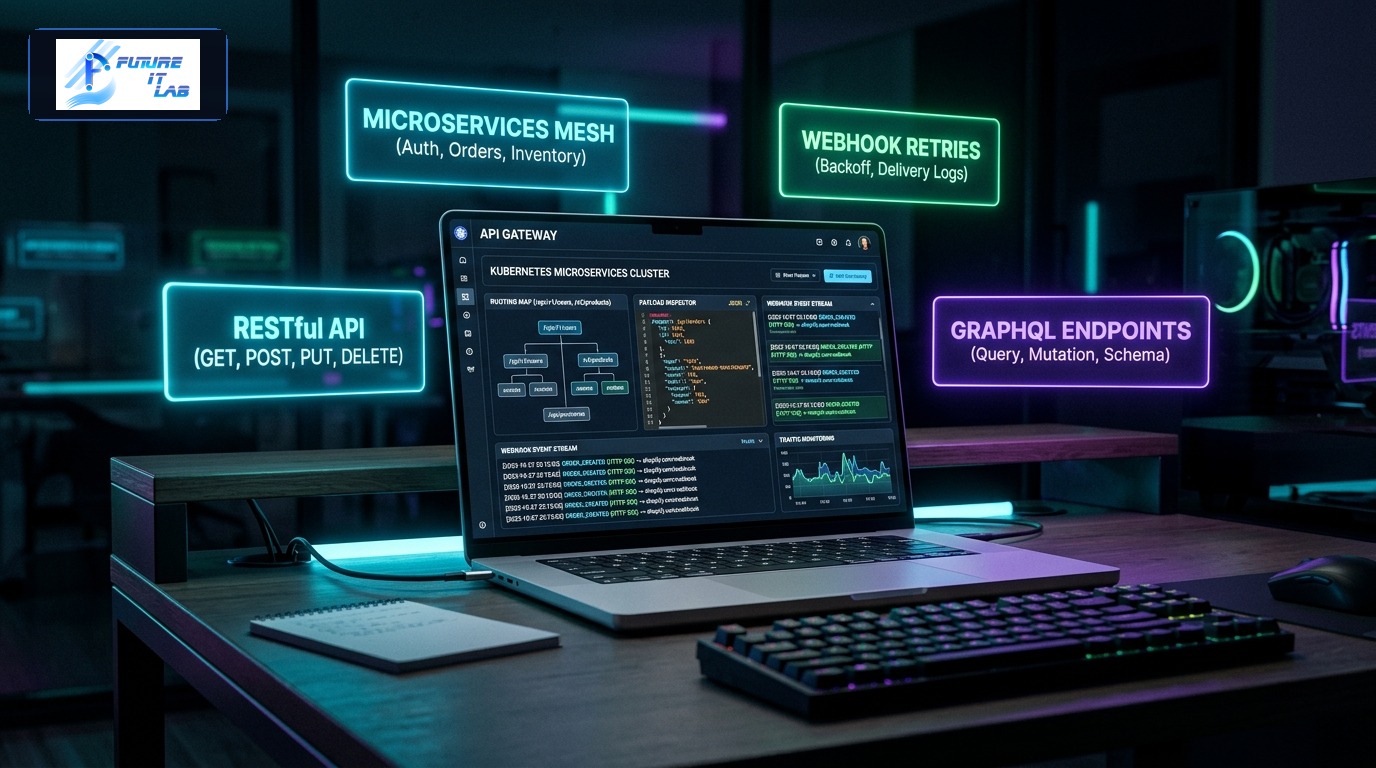
Modern web applications rarely exist in isolation. They operate within interconnected ecosystems, orchestrating data exchanges with payment processors, mobile applications, CRM platforms, ERP systems, AI models, and external partner networks. Application Programming Interfaces (APIs) serve as the vital bridges enabling this seamless interoperability.
Designing an enterprise API requires foresight. An insecure, inconsistent, or unversioned API quickly accumulates technical debt, breaks client integrations, and introduces security vulnerabilities. In this engineering playbook, Future IT Lab breaks down the architectural standards for designing high-performance RESTful APIs, GraphQL endpoints, and resilient webhook event pipelines.
Representational State Transfer (REST) remains the industry standard for web services due to its simplicity, HTTP cacheability, and widespread tooling support.
GET /api/v1/orders instead of /api/v1/getOrders).GET: Safe and idempotent resource retrieval.POST: Creation of new resources.PUT: Complete resource replacement.PATCH: Partial resource modification.DELETE: Resource removal.200 OK, 201 Created, 400 Bad Request, 401 Unauthorized, 403 Forbidden, 404 Not Found, 422 Unprocessable Entity, 429 Too Many Requests).While REST dominates general web services, GraphQL provides distinct advantages for complex, deeply relational data structures and multi-platform client applications.
| Dimension | RESTful Architecture | GraphQL Architecture |
|---|---|---|
| Data Over/Under-Fetching | Endpoints return fixed data structures, risking over-fetching on mobile. | Clients query exactly the fields they need in a single request. |
| Network Caching | Effortlessly cached via native HTTP headers (ETag, Cache-Control). | Requires complex client-side caching mechanisms (Apollo Cache). |
| API Versioning | Handled via explicit URI versions (e.g., /api/v1, /api/v2). |
Evolves via continuous schema deprecation without breaking versions. |
| File Uploads & Binary Payloads | Native and straightforward via multipart/form-data. | Requires separate REST endpoints or multipart specs. |
At Future IT Lab, we recommend REST for public partner APIs, payment integrations, and resource-centric CRUD platforms, while deploying GraphQL for data-dense administrative dashboards and mobile apps with complex relational views.
While APIs allow clients to pull data on demand, Webhooks allow systems to push real-time event notifications to subscribers when critical state changes occur (e.g., order paid, invoice generated, user registered).
X-Webhook-Signature). Receivers verify the signature to authenticate sender identity.event: "order.created.v2") to support non-breaking consumer upgrades.Public APIs are frequent targets for scraping, denial-of-service, and credential attacks. Robust API gateway security mandates:
A well-architected API accelerates business growth by turning your web application into an extensible platform that partners, clients, and mobile applications can easily build upon. At Future IT Lab, our engineers build robust, documented, and secure API infrastructure capable of processing millions of transactions with sub-millisecond precision.
Need custom API engineering or seamless third-party software integration? Discover our custom software development services or contact our API architects today.